

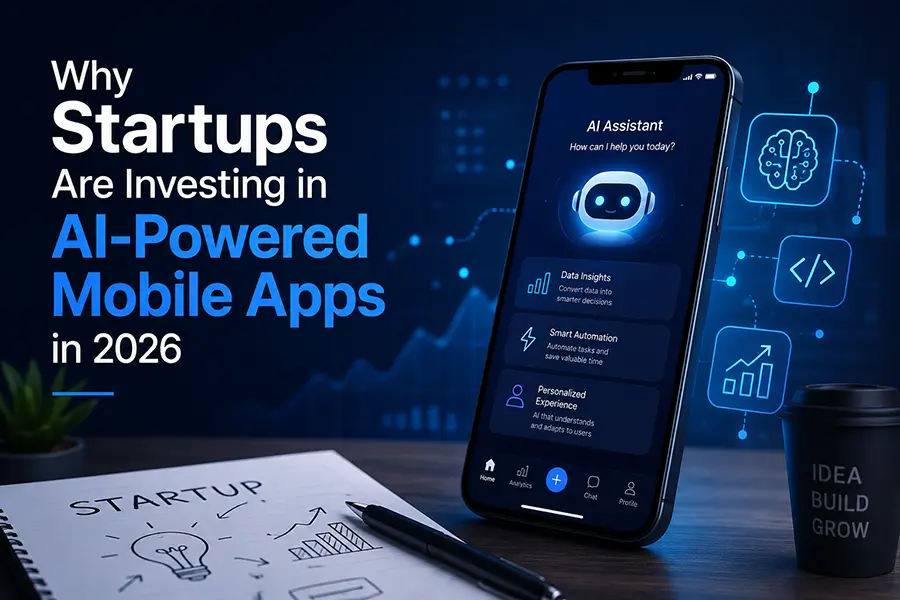
Artificial intelligence is no longer a futuristic concept. In 2026, it’s become one of the biggest competitive advantages for startups to launch products that solve the real customer problems. Start-ups are using AI to create faster, smarter, more responsive applications, from personalised shopping experiences and AI-driven healthcare assistants to intelligent financial tools and customer service chatbots.
The startup ecosystem has changed dramatically over the last few years as well. Today’s customers expect mobile apps to understand their preferences, provide instant support, perform repetitive tasks and offer highly personalized experiences. Existing mobile app development, which is based on a fixed set of rules, often cannot meet these expectations. AI fills this gap by allowing applications to learn from user behavior, make predictions and get better over time.
In startups with limited budgets and tight timelines, AI is no longer an innovation strategy, it’s a practical investment that enhances operational efficiency, customer satisfaction, and long-term growth.
The Growing AI Economy Is Reshaping Startup Strategies
Startups are rethinking how they build digital products as AI is being adopted across industries. As AI gets embedded deeper into product offerings, investors are backing more and more companies with AI-enabled solutions, which tend to show better scalability and more engagement from customers.
The global artificial intelligence market is expected to continue its growth at a rapid pace throughout the decade, according to Grand View Research, which cites increased enterprise adoption, cloud computing and advancements in machine learning technologies.
AI could contribute up to nearly $15.7 trillion to the world economy by 2030, PwC also estimates, making it one of the biggest tech transformations to modern business.
That’s why so many startups are incorporating AI into their products from day one, rather than treating it as an optional feature to be added later in the development process.
Why AI-Powered Mobile Apps Are Becoming the New Standard
Today, modern consumers use dozens of mobile apps per day. They compare experiences across platforms, and they quickly ditch apps that feel slow, generic or difficult to use.
Applications can leverage artificial intelligence to deliver more intuitive experiences, enabling startups to:
- Recommend contents based on user behavior
- Automate customer support with smart assistants
- Anticipate customer preferences
- Detect abnormal activities for better security
- Improve the accuracy of the search
- Customize notifications and suggestions
- Automating business processes
AI is about making applications adapt to individual users rather than making users adapt to an application.
This change is a big win for user satisfaction and allows startups to keep customers longer.
Personalization Has Become a Competitive Advantage
Personalization is one of the most compelling reasons for entrepreneurs to invest in AI.
Today’s consumers expect software to recognize their choices practically instantly. Whether someone is purchasing meals, scheduling a trip, studying online, or managing assets, consumers enjoy recommendations that are relevant to their interests and do not require additional work.
Artificial intelligence analyzes user interactions, purchasing history, browsing activity, and engagement patterns to provide real-time suggestions.
Popular consumer platforms have previously shown how customization affects engagement. Streaming services promote material based on viewing patterns, online shops recommend things that are similar to prior purchases, and financial apps provide personalized spending data.
Startups use the same concepts to develop products that feel valued from the first contact.
Personalization Has Become a Competitive Advantage
Unlike major corporations, startups often operate with little resources.
Hiring huge customer service teams, manually analyzing data, and monitoring thousands of user interactions may soon become costly.
AI enables firms to automate many of these tasks without losing user experience.
Intelligent chatbots, for example, can answer basic client queries around the clock, and document-processing systems automatically classify material, decreasing administrative effort.
Marketing teams may also utilize AI to assess campaign effectiveness, discover audience patterns, and create insights much faster than with typical manual reporting.
This automation enables business owners and workers to spend more time developing products rather than managing tedious operational activities.
Faster Product Decisions Through Data
Every business collects data, but not all startups understand how to use it successfully.
AI converts raw data into valuable business intelligence.
Instead of manually examining spreadsheets or customer comments, AI algorithms may detect trends, forecast user behavior, and highlight possible possibilities before they become apparent.
For example, an eCommerce firm can determine which goods are likely to be popular next month.
A healthcare startup may detect patient engagement patterns.
An education platform may provide tailored learning routes depending on student achievement.
These insights empower entrepreneurs to make faster and more informed decisions, lowering company risks.
Customer Support Is Becoming More Intelligent
Customer service expectations continue to rise.
Users no longer want to wait hours, or even minutes, for easy answers.
AI-powered virtual assistants respond instantly and handle regular assistance queries around the clock.
Unlike older chatbot systems that used programmed replies, contemporary conversational AI understands natural language, detects context, and provides more useful interactions.
This increases client happiness while lowering support expenses.
For startups with rapidly increasing user bases, intelligent customer service may greatly enhance scalability without necessitating commensurate workforce increases.
Better Security Builds Customer Trust
As digital transactions continue to grow, cybersecurity has become a key worry for both businesses and consumers.
Artificial intelligence improves mobile app security by constantly monitoring user behavior and detecting questionable conduct.
Machine learning models can identify anomalous login attempts, detect fraudulent transactions, and alert to aberrant account activity far faster than traditional rule-based systems.
These features benefit finance, healthcare, and eCommerce firms by protecting sensitive client information and enhancing regulatory compliance.
Building trust early on is frequently one of the most significant benefits that a business can gain.
AI Is Accelerating Mobile App Innovation
Rapid advancements in cloud computing, generative AI, and machine learning frameworks have made AI application easier than ever before.
Businesses no longer require extensive research teams to incorporate intelligent features into their apps.
Cloud providers increasingly provide pre-built AI services such as speech recognition, computer vision, recommendation engines, translation, predictive analytics, and natural language processing.
As a result, entrepreneurs may release complex AI-powered products much more quickly while keeping development expenses under control.
Working with a trusted mobile app development company in Toronto can also make it easier to include these sophisticated features into scalable mobile solutions while decreasing technical complexity.
Why Startups Are Investing in AI-Powered Mobile Apps in 2026
1. Faster Customer Acquisition Through Smarter User Experiences
For startups, gaining new users is only half the battle; keeping them engaged is what drives long-term success.
AI-powered mobile apps enable businesses to provide tailored experiences from the very first encounter.
Instead of presenting each user the same interface or suggestions, AI uses browser history, user preferences, purchase behavior, and engagement patterns to adapt information in real time. This amount of customisation improves relevance, increasing the likelihood that users will continue to use the app.
According to McKinsey & Company, firms that successfully deploy customization tactics may achieve much greater customer satisfaction and revenue growth than competitors that rely on generic experiences.
Example: Rather than showing the same list to every client, a food delivery business may recommend eateries based on prior orders, dietary preferences, delivery location, and ordering time.
2. AI Helps Startups Build Scalable Products from Day One
One of the most difficult problems that startups confront is preparing for quick expansion. Applications that work well with a few thousand users may suffer when demand spikes suddenly.
Artificial intelligence allows firms to automate numerous activities that would otherwise need more labor or infrastructure.
AI may help with:
- Customer onboarding
- Content moderation
- Product recommendations
- Fraud detection
- Support ticket classification
- Inventory forecasting
This automation lowers operating costs while allowing organizations to grow without incurring additional investments.
Cloud platforms like Google Cloud, Microsoft Azure, and AWS also provide managed AI services, making sophisticated capabilities available to even early-stage businesses.
3. Investors Are Paying More Attention to AI-Driven Startups
Artificial intelligence continues to draw considerable venture capital investment because investors regard it as a long-term business enabler, rather than a passing fad.
Startups that incorporate AI into their products often demonstrate:
- Better operational efficiency
- Higher customer retention
- Stronger data-driven decision making
- Greater scalability
- More attractive recurring revenue models
Investors are increasingly looking at how firms utilize AI to solve genuine business problems rather than just adding AI capabilities for marketing purposes.
This trend pushes innovators to include AI in their primary product strategy from the start.
4. Industry-Specific AI Applications Are Creating New Opportunities
AI usage is no longer exclusive to IT enterprises.
Startups across a variety of sectors are leveraging intelligent mobile applications to improve efficiency and consumer experiences.
- Healthcare – Healthcare firms are creating AI-powered mobile apps to help with appointment scheduling, symptom assessment, prescription reminders, and patient interaction. Predictive analytics can also assist healthcare providers identify high-risk individuals and arrange more effective treatments.
- Financial Technology – FinTech apps employ artificial intelligence (AI) to identify fraudulent transactions, automate budgeting, give spending insights, and make tailored financial suggestions.
- Retail and eCommerce – Through conversational assistants, retail entrepreneurs use AI to promote items, estimate inventories, optimize pricing, and improve customer service.
- Education – AI is used in educational platforms to develop adaptive learning experiences that modify the difficulty of lessons based on individual student performance.
- Logistics – Artificial intelligence is used by logistics firms to optimize delivery routes, estimate arrival times, monitor fleet performance, and forecast maintenance needs.
These industry-specific application cases indicate that artificial intelligence has evolved from an experimental technology to a useful commercial tool.
5. Predictive Analytics Improves Business Decisions
Many startups use historical records to assess business success.
AI takes a step further, assisting entrepreneurs in anticipating future events.
Predictive analytics enables startups to forecast:
- Customer churn
- Product demand
- Sales performance
- Marketing campaign effectiveness
- Inventory requirements
- Seasonal buying behavior
Instead of responding to problems as they arise, firms may make proactive decisions based on data-driven forecasts.
According to IBM, predictive analytics improves operational efficiency while lowering company risks through improved forecasting.
6. AI Strengthens Customer Retention
Acquiring new clients is expensive, thus retention is a top goal for entrepreneurs.
AI-powered engagement techniques help organizations keep people engaged by delivering:
- Personalized recommendations
- Intelligent push notifications
- Relevant promotions
- Customized onboarding journeys
- Context-aware support
Instead of delivering the same notice to each user, AI determines the relevant message at the right moment depending on individual behavior.
This results in a more meaningful client experience while lowering notification fatigue.
Salesforce research shows that customers increasingly expect firms to understand their preferences and deliver tailored experiences across digital platforms.
7. AI Is Becoming More Affordable Than Ever
Several years ago, applying AI needed specialized research teams and significant infrastructure expenditures.
Startups may now incorporate sophisticated capabilities using cloud-based APIs, pre-trained machine learning models, and open-source frameworks.
Services like OpenAI, Google Cloud AI, Microsoft Azure AI, and AWS AI allow startups to add features like:
- Natural language processing
- Image recognition
- Speech-to-text
- Recommendation engines
- Document processing
- Conversational AI
This accessibility has considerably reduced the barrier to AI adoption, allowing entrepreneurs to focus on addressing consumer issues rather than developing sophisticated AI systems from scratch.
As a result, many entrepreneurs collaborate with experienced top app developers Toronto that understand how to incorporate AI technology into scalable mobile applications while ensuring performance and security.
Building AI Products Requires the Right Development Partner
Artificial intelligence is just one part of a great mobile application.
Startups require scalable architecture, appealing user experiences, secure infrastructure, and constant optimization.
Choosing skilled IT software development company can assist firms in combining AI capabilities with solid software engineering techniques, ensuring that their products stay stable as user demand develops.
The most successful AI-powered apps are designed with a long-term product plan, rather than merely adding clever features after launch.
The Future of AI-Powered Mobile Apps Beyond 2026
Artificial intelligence will continue to affect how entrepreneurs design and expand mobile applications, but the emphasis is changing away from merely adding AI capabilities and toward building experiences that truly address user issues.
Several themes are predicted to influence the next generation of mobile apps in the coming years.
- Generative AI as a Core Feature – Generative AI is becoming a common feature in many applications, allowing users to produce content, summarize information, automate operations, and communicate with software using natural language. Startups that carefully combine these features can increase productivity and user engagement.
- Voice and Multimodal Interfaces – Advances in speech recognition and computer vision are increasing the prevalence of voice commands, image-based searches, and multimodal interactions.
This opens up potential for entrepreneurs to streamline difficult user journeys. - Hyper-Personalization – AI models will continue to develop suggestions based on real-time behavioral data, while adhering to privacy standards. Customers are increasingly expecting applications to grasp their preferences without requiring several inputs.
- Predictive Decision-Making – Instead of just providing past data, future AI-powered apps will assist organizations foresee market trends, consumer wants, and operational hazards, allowing them to make faster and more educated decisions.
- Responsible AI Development – As AI usage increases, entrepreneurs must consider openness, data protection, fairness, and regulatory compliance. Building trust through appropriate AI techniques will become an important distinction.
Common Mistakes Startups Should Avoid
While AI has several potential, its deployment necessitates meticulous preparation.
Many businesses have difficulties because they prioritize technology above defining the business problem they wish to address.
Here are some typical errors you should avoid:
- Implementing AI Without a Clear Purpose – Artificial intelligence should meet a genuine user or business demand. Adding AI solely because it is fashionable might raise development expenses without providing significant value.
- Ignoring Data Quality – Machine learning algorithms require reliable and relevant data. Incomplete or biased datasets might lead to inaccurate forecasts and bad user experiences.
- Overlooking Privacy and Compliance – Applications that handle personal information must adhere to legislation such as GDPR, PIPEDA, HIPAA, and industry-specific requirements. Security and privacy should be considered throughout the whole development process.
- Underestimating Maintenance – AI models must be continuously monitored, updated, and retrained as user behavior and business situations change. Long-term maintenance should be on the product plan.
- Neglecting User Experience – Even the most powerful AI capabilities cannot make up for a confusing UI. A smooth, intuitive user experience is still critical for user uptake and retention.
Conclusion
Artificial intelligence has evolved from an experimental technology into a real growth engine for companies.
In 2026, AI-powered mobile applications will help organizations automate processes, customize consumer experiences, enhance decision-making, boost security, and grow more effectively.
As AI technologies become more available, entrepreneurs will have more opportunity to compete with established companies by providing novel digital experiences. Long-term success, however, is dependent on the strategic use of AI, which is backed by high-quality data, prudent development procedures, and a thorough grasp of client requirements.
Startups that engage in deliberate AI implementation now will be better positioned to react to shifting market demands, strengthen customer connections, and achieve long-term success in the coming years.
Frequently Asked Questions
1. Why are startups adopting AI-powered mobile apps in 2026?
Startups are utilizing artificial intelligence to automate company operations, provide tailored user experiences, improve customer care, boost security, and make data-driven choices while lowering operating costs.
2. Which industries benefit the most from AI-powered mobile applications?
Healthcare, finance, retail, logistics, education, real estate, and travel are among the industries benefiting greatly from AI-powered mobile applications.
3. Is AI only suitable for large enterprises?
No. Cloud-based AI services and pre-trained machine learning models have made AI more accessible to startups and small enterprises, allowing them to add intelligent features without requiring considerable equipment.
4. What challenges should startups consider before implementing AI?
Data quality, user privacy, regulatory compliance, continuing model maintenance, integration complexity, and ensuring AI meets a legitimate business need are all important factors.
5. How can startups maximize the return on AI investments?
Startups should start with clearly defined business goals, target high-value use cases, employ accurate data, routinely check AI performance, and iteratively improve their products based on user input.
Author Bio
Nilesh Dhobi is an SEO professional with over 9 years of experience helping businesses grow their online presence through strategic search marketing and sustainable organic growth. As the SEO Manager at iQlance Solutions Canada, a leading provider of app development services in Toronto, he has worked with startups, enterprises, and global brands across a wide range of industries. Nilesh specializes in SEO strategy, content marketing, and user-focused digital growth. Passionate about staying ahead of evolving search trends, he regularly shares practical insights to help businesses improve their online visibility. His expertise and industry contributions have also been recognized by Search Engine Roundtable.